UPDATE OF CLIMATE ADAPTION WORK IN SWEDEN - WHAT HAS BEEN DONE THIS FAR AND WHAT REMAINS TO BE DONE?
 |
| Defining the road forward |
As the
climate changes, actors on all levels and in all sectors will be affected. Thus
it is imperative that authorities, municipalities, businesses and individual
property owners all take action.
Flooding,
heat waves, landslides and erosion are only a few examples of the challenges
that that society faces and needs to prepare for. Sweden must adapt to the
impacts of a changing climate, as well as the indirect effects of climate
change impacts in other parts of the world.
The costs
of adaptation can be high, but the European Commission, among others, has
deemed that it still pays to adapt in relation to the costs incurred if no
action is taken.
Climate
adaptation initiatives in Sweden have advanced significantly in recent years.
Notable examples include governmental missions for a national elevation
database, landslide risk mapping in the Göta Älv River Valley, the Swedish
drinking water investigation, the County Administrative Boards’ regional
climate change action plans, and the establishment of the National Knowledge
Centre for Climate Adaptation.
The Swedish
Meteorological and Hydrological Institute’s mission to survey, analyse and follow-up on
climate adaptation work in Sweden has shown that there is still a considerable
need for further measures. This report provides proposals for a road map for
climate adaptation in Sweden and concludes that climate adaptation is best
conducted in a long-term manner, that roles and responsibilities should be made
more transparent, and that better coordination among the many actors involved
in climate adaptation is necessary.
The most important conclusions for continued
work are:
- Laws and regulations need to be adapted;
roles and responsibilities as well as strategies and goals should be made
clearer.
- Priority and funding should be given to
research and development measures that fill an identified knowledge-gap,
including long-term monitoring.
- Knowledge and decision support as well as
prognoses and warning systems should be more accessible.
- There is a need to outline how the costs
of adaptation should be distributed among actors and how resources for
prioritised measures can be guaranteed.
This mission
has compiled knowledge of the current and future risks and consequences for society
of a changing climate, such as effects on vital societal functions and human
health. The mission has also surveyed the work that has been done since the
publication of the final report of the Swedish Commission on Climate and
Vulnerability in 2007. From this background material our goal has been to
describe the gaps and challenges and provide suggestions for how adaptation can
be approached in various sectors of society. The EU Strategy on Adaptation to
Climate Change has been an important point of departure. The work has been
performed in cooperation with national and regional authorities,
municipalities, researchers, sectoral organisations and representatives of the
private sector.
The work has been coordinated by Dr. Lotta Andersson who also is project leader for DEWD.
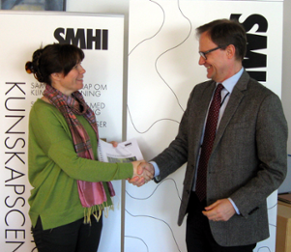 |
| The Director of SMHI Mr Rolf Brennerfelt hands over the report to Ms, Åsa Romson Minister of Climate and Environment |


